Architects in Costa Brava
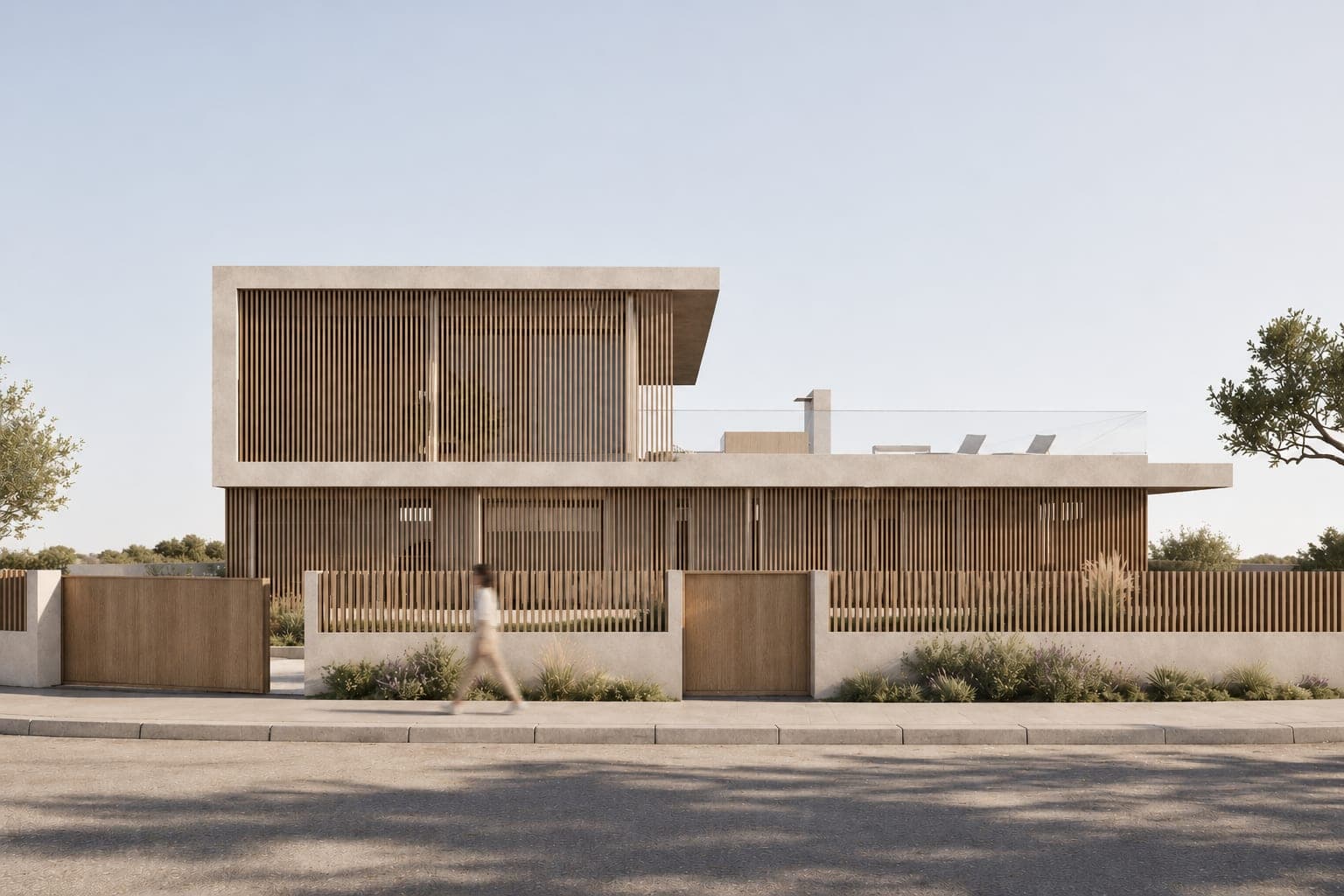
In Costa Brava we designed a house that floats over the course, protected from the sun by a second skin of slats. Here architecture is decided between the sea, the strong light and rules that protect the coastline.
Architecture between the sea and the forest
Costa Brava is a coastline of coves, pine forest and stone villages. The houses that work best here are the ones that understand three things: the strong summer sun, the damp and salt of winter, and a landscape that the rules protect because too much has already been built on it.
Many of the houses designed in Costa Brava are second homes. That changes the project: the house has to close up well when you are away, need little upkeep and open up completely when you arrive.
Our work in Costa Brava
GR16 · Casa Golf, floating over the course. A new-build home with a basement, a Mediterranean garden and a pool, open to the golf course and protected by a second skin of slats that filters the light and gives privacy without closing off the views.
What we do in Costa Brava
- New-build houses, as main or second homes.
- Full renovations of houses from the sixties to the nineties: insulation, windows, services and a layout that opens to the outdoors.
- Extensions, when the planning rules allow it.
- Site supervision and project management for owners who live far away.
The Ley de Costas and the protection strip
If the house is near the sea, the first thing is to know whether the Ley de Costas affects it. The law sets a protection easement of 100 metres inland from the inner edge of the shoreline, reduced to 20 metres on land that was already classed as urban when the law was passed in 1988. Within that strip, existing buildings are respected, but new works and some renovations have limitations and may need an authorisation from the relevant administration as well as the municipal permit.
On top of that come the planning rules specific to the Catalan coast and to each town, which along many stretches have protected land that could once be developed. We go into it in renovating or building in Costa Brava.
Materials that withstand the coast
Near the sea, choosing materials is part of the architecture and also of the upkeep. Stone, ceramics, mineral mortars, timber prepared for outdoor use, external sun shading on the most exposed façades and window frames designed for marine environments. Noble materials that age well instead of deteriorating.
How we start
The first visit is free. We come to the plot or the house, check what restrictions apply and tell you what can be done.
Our work in the area
Questions about Costa Brava
Can I renovate a house near the sea in Costa Brava?
Usually yes, but you need to know whether the house lies within the protection easement zone of the Ley de Costas (100 metres from the shoreline, 20 metres on land that was already urban in 1988). Within that strip, works have limitations and may need an authorisation as well as the municipal permit.
Do you design second homes if I live abroad?
Yes. We organise the project so you can decide remotely: meetings at the studio or online, clear documentation and regular site visits on your behalf.
Which materials work best near the sea?
Those that age well with salt, sun and damp: stone, ceramics, lime mortars, timbers suited to outdoor use, and window frames and fittings designed for marine environments. We define them in the construction design.
What if the plot is in a protected area?
Part of Costa Brava coastline is protected by specific planning schemes and natural areas. Before designing, we check the plot’s zoning and any restrictions on it.
Worth reading before you start
Restoring a masia in Girona
Restoring a masia in Girona: the catalogue of masias and country houses, the existing volume, the permitted uses and what to check before buying.
Project management and site supervision
Site supervision and project management: what each one does, how they differ and when it makes sense to hire them for your home.
The phases of a full renovation with an architect
The seven phases of a full renovation with an architect: first visit, preliminary study, design, permits, hiring the builder, site supervision and handover.
The habitability certificate in Catalunya
What the habitability certificate (cédula) is in Catalunya, its three types (first occupation, restoration, second occupation) and when to apply after works.
Renovating or building a house in Costa Brava
the Ley de Costas in Costa Brava: the 100 and 20 metre protection easement, which works are allowed and which materials withstand the sea.
How we work
- 01
First visitFree
We come to your home or your plot. We listen, measure and tell you honestly what can be done.
- 02
Preliminary study
Options on paper, an indicative budget and a realistic timeline before you decide anything.
- 03
Project
Basic and construction design, permits, materials and details. Everything needed to build well.
- 04
Construction
Site supervision and cost control until handover. We are on site, not just in the office.
Phases and scope are confirmed during the first visit, depending on the type of project.
Let’s start with a visit.
Free and with no strings attached. We tell you honestly what can be done with your home.