Which permit you need to renovate an apartment in Barcelona
Before asking for quotes, it is worth knowing which filing your renovation requires. In Barcelona, changing the kitchen is not the same as removing a partition or opening a gap in a load-bearing wall.
The short answer
In Barcelona, any works in a building need some kind of municipal permission. Which one depends on three things: what you touch (finishes, layout, shared services, structure, façade), where the building is and whether it has heritage protection. The rule that governs it is the ORPIMO, the bylaw on municipal procedures for building works, and the City Council recommends always starting with a prior consultation that determines the route for your works.
The three routes
| Filing | Typical works | Needs a professional? |
|---|---|---|
| Immediate notice | Painting, replacing floors, renewing a kitchen or bathroom without moving shared services | No |
| Notice with technical certificate | Interior layout changes that do not affect the structure | Yes |
| Building permit | Structure, façade, volume, changes of use, protected buildings | Yes, with a full design |
The table is a guide: the exact route for your case is set by the prior consultation. The same partition can be a simple filing in one apartment and a more demanding one if the building is listed.
Immediate notice
This is the filing for small works. You submit the documents, pay the fee and, once paid, you can start. It covers works that do not alter the structure, the overall layout, the façade or the common elements.
Notice with technical certificate
When the renovation changes the apartment’s layout or has a wider scope, but without touching the structure, the City Council asks for a qualified professional to certify the works. This is where the building’s Technical Suitability Report (IIT) comes in: to file this notice you have to give its reference number.
Building permit
If the works affect the structure (opening a gap in a load-bearing wall, changing a floor slab), the façade, the volume or the use, or if the building is protected, you need a permit, with a design drafted by an architect. The IIT is required here too. The prior planning report is issued by the City Council itself within the process.
The prior housing report
Since the 2018 amendment of the ORPIMO, some works also need a prior report from the housing services. It is required, among other cases, for major restorations, for works affecting the building’s structure or foundations and for changes of use. Its purpose is to check that the people living in the building are guaranteed rehousing and return if the works prevent them from staying in their homes. Without that report the IIT cannot be filed.
What usually changes the filing
- Touching the structure. In many Eixample and Gràcia buildings the interior walls are load-bearing. What looks like a partition may not be one.
- The building’s protection. Many buildings from the late 19th and early 20th centuries are listed or included in a special plan.
- Common elements. Downpipes, light wells, façade and roof belong to the community of owners: touching them also requires their agreement.
- Shared services. Changing the building’s gas or electricity supply is not the same as renewing the installation inside the apartment.
And at the end: the habitability certificate
If the renovation substantially changes the description of the home (for example, a complete new layout), its existing second-occupation habitability certificate no longer describes it. In those cases you have to apply for a first-occupation certificate for restoration. We explain it in the habitability certificate in Catalunya.
An example
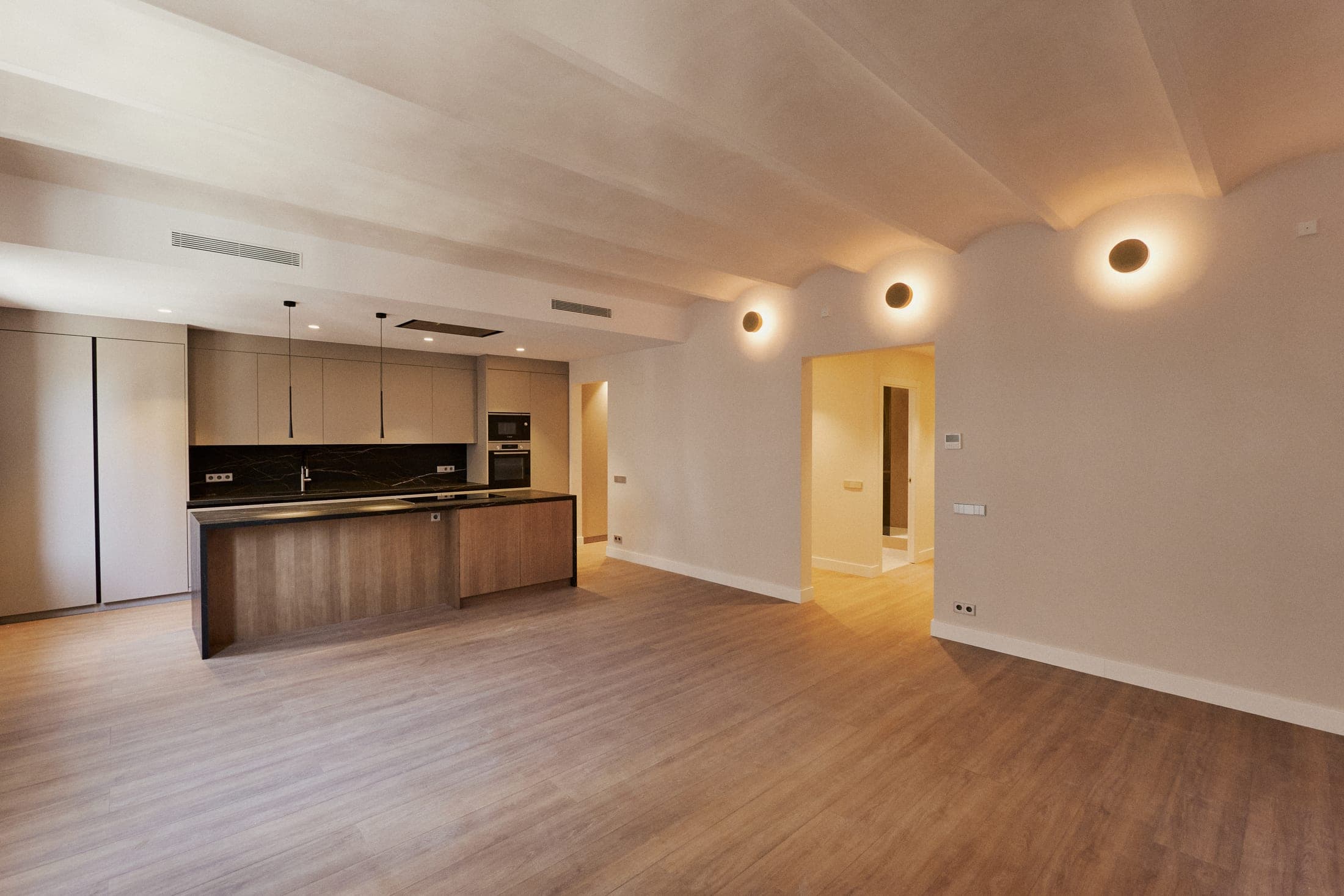
In PE17, a compact apartment in Gràcia, we kept the courtyard, the wooden joinery and the Catalan vault while reorganising the home towards the balcony. In CO38, an Eixample apartment that had been used as an office, the renovation included restoring its use as a home. In both cases, knowing what could be touched came first.
How we do it
At the first visit, which is free, we see the apartment and the building. In the preliminary study we make the prior consultation, identify the filing and include it in the schedule. So when the construction quote arrives, you already know which permit you need and how long it will take. If your apartment is in Barcelona, see also our page on architects in Barcelona.
This article summarises public regulations for information purposes. Every case depends on its plot, its building and the current wording of the rules: check before deciding.